
Unfortunately, Internet Explorer is an outdated browser and we do not currently support it.
To have the best browsing experience, please use Google Chrome, Firefox, Microsoft Edge or Safari.
We use cookies to improve your experience on our website. By continuing to browse this website, you agree to our use of cookies. For more information, please refer to our privacy policy.


This is a self-funded case study using our ad testing solution. Curious about the 9 essential ingredients for creating advertising that drives profitable growth? Explore our Creative Effectiveness Playbook.
Too often, advertisers rely on an overly narrow emotional palette in their advertising, which comes to the detriment of creative effectiveness. We firmly believe that when advertisers consider the full spectrum of human emotions, it leads to more distinctive brands and more impactful work. Which means that, yes, for the right brand in the right circumstances, feelings of annoyance and irritation can and do have a role to play. When you consider that emotions are simply the gateway for advertising to get noticed in the first place, it’s not surprising that intense negativity can serve a valuable purpose.
There’s little value, therefore, in taking an overly narrow view of what creative effectiveness looks like, and assuming that only the warm and pleasant end of the emotional spectrum is worth exploring. In fact, brands that limit themselves to this territory (think: endless rainbows, cute puppies, and Christmas cheer) often end up disappearing into the dreaded sea of sameness – a topic we’ve written about extensively during the U.K. festive season.
Given that standing out in an ever-crowded landscape is the first hurdle that all advertising must overcome, the emotional dark arts offer an intriguing tool in this pursuit. Annoyance and irritation, when used with purpose, disrupt the default passive way advertising is generally consumed, forcing people to sit up, take notice, and ultimately remember. But the key is intent. Irritation should be the vehicle to elevate the idea, the emotions, and the brand – rather than simply acting as a shortcut to attention.
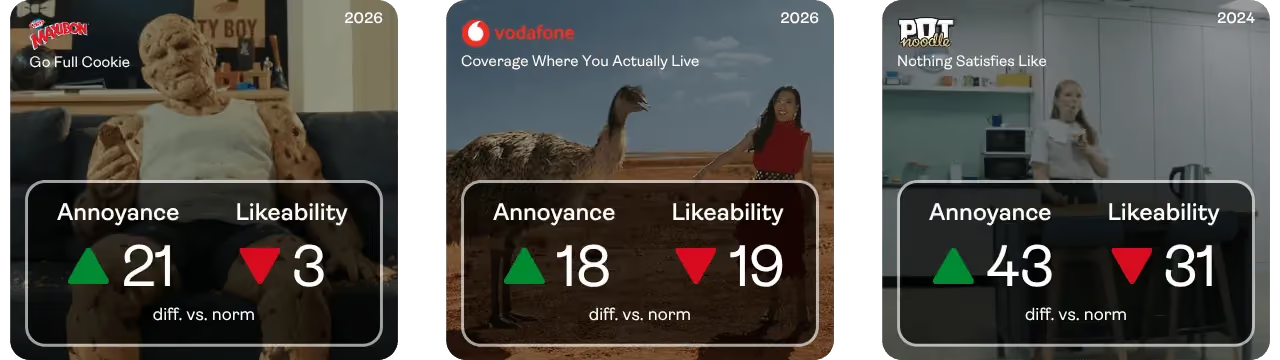
Take Maxibon’s “Go Full Cookie” campaign from 2026. Yes, the piercing screams, chaotic energy, and bizarre premise of a person turning into a cookie resulted in annoyance levels that sat in the top 2% of ads in Australia. But crucially, annoyance was part of the joke – rather than the entire experience.
What started as grating quickly turned into something entertaining, which meant the ad was able to capture attention without overstepping the mark – ensuring the negativity was used for productive purposes. This meant it didn’t detract significantly from the ad’s overall appeal, brand encoding, or message take out.
In saying that, this combination of irritation and entertainment is a rare feat, with our global creative archives confirming the steep inverse correlation between feelings of irritation and overall emotional appeal. Just ask Vodafone, Pot Noodle, and a swathe of others who’ve gotten this balance wrong over the years.
But the key point is this: when advertising successfully combines the two, it’s almost unparalleled in its ability to cut-through and get noticed.
Watch: Maxibon, Vodafone, and Pot Noodle.
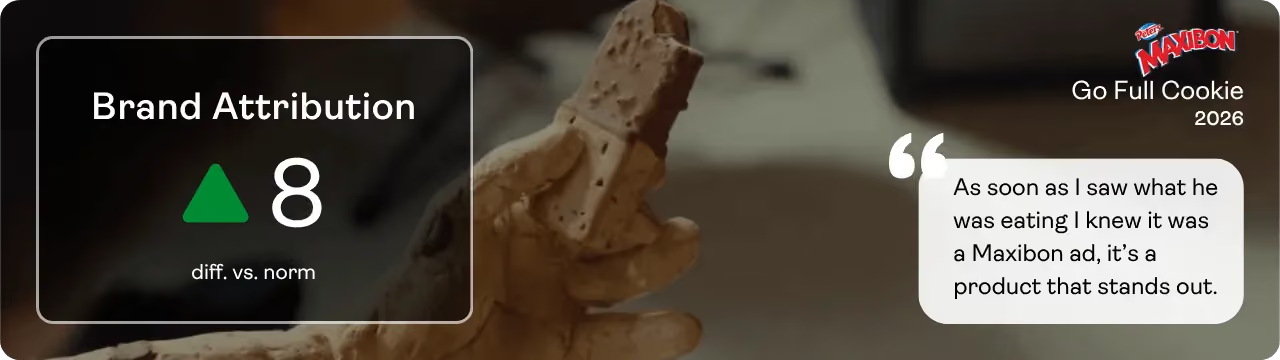
For Maxibon, these same annoying elements also worked to focus people’s attention on the brand, rather than smother it. Maxibon wasn’t just present within the chaos – it was the catalyst for it. This central role ensured people remembered the ad as much for the brand as the bizarre theatrics.
But more broadly, consider that memory structures are built and refreshed over the long-term by adopting a look, feel, and tone that continually harmonizes with what people have come to expect from the brand. Put another way, advertisers should be clear and intentional about the emotions they want their brand to be associated with, and the feelings that advertising then triggers should consistently align with these.
Therefore, ensuring an irritating or annoying theme synergizes with people’s pre-existing ideas of the brand helps solidify long-term memory structures, which is something Maxibon has achieved through relentless consistency over many decades.
On the other hand, if irritation veers wildly from what people have come to expect from the brand, confusion is often the result. Our databases again paint a clear story, highlighting the negative impact confusion has on whether the brand is embedded into people’s long-term memories.
Take Carlton Dry’s “Drylandia” from 2023. While the alien-cult fever dream leant into disorienting irritation in an effort to stand out, its stark pivot versus the brand’s previous campaigns jarred heavily with what people have come to associate with the brand – making it harder for people to link the ad back to Carlton Dry.
A clear and consistent approach to the emotions a brand targets is therefore key to embedding a personality and feeling that unmistakably cues the brand.
Watch: Carlton Dry.

While challenger brands often use annoyance and irritation in an effort to make their presence known, the subsequent attention earned counts for little if:
a) the new and unfamiliar brand is not a key driver of the narrative, or
b) the ad doesn’t land a motivating message.
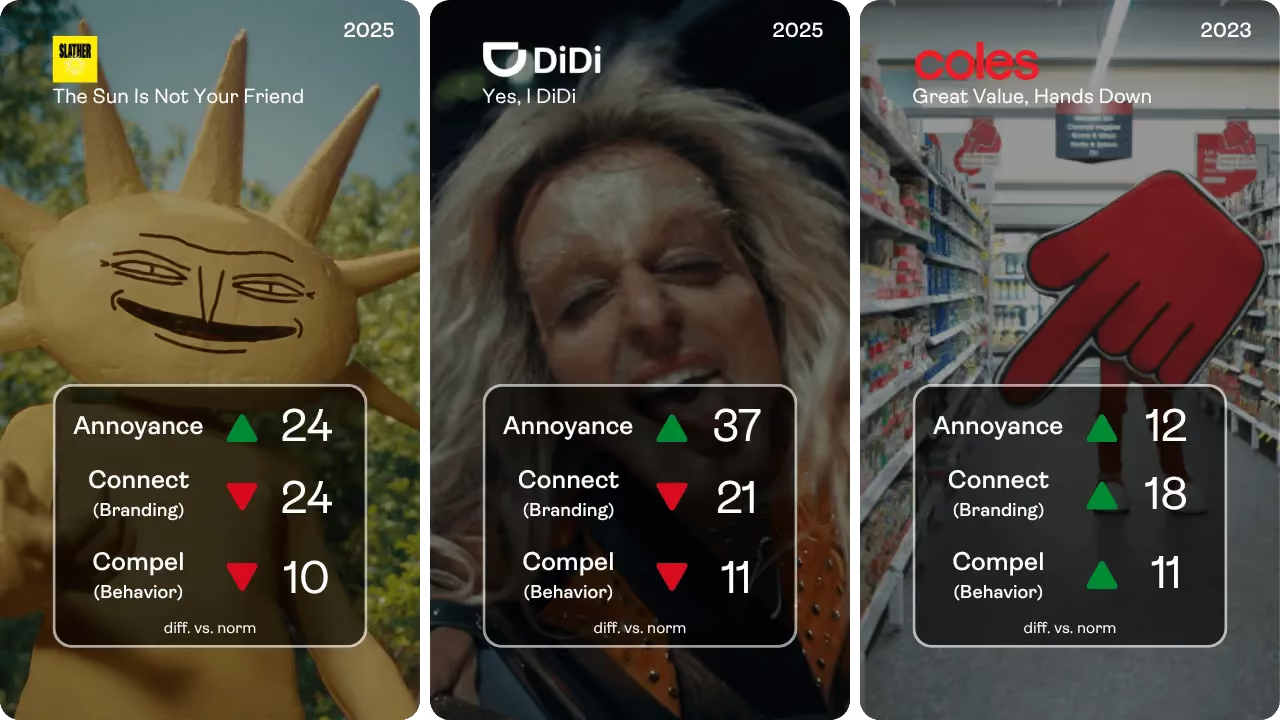
Australian sunscreen brand Slather introduced themselves in 2025 with a literal face-melting campaign that stirred fear and anxiety in spades, working incredibly effectively to demand attention in an otherwise conservative category. However, people weren’t able to see past the shock factor of the dramatized burning skin to grasp who the brand was or how it solves the problem at hand.
Similarly, rideshare company DiDi’s push to close the gap with market leader Uber resulted in similar shock factor with its high profile “Yes, I DiDi” campaign. But again, while the flute playing Nudgy and sideshow friends worked brilliantly to turn people’s heads (consequently seeing it land on The Cubery Hot List repeatedly over the last year), the core takeaways of the brand being affordable, convenient, and trusted were somewhat lost in the fever-dream narrative. This consequently limited the ad’s ability to build mental availability for DiDi during the moments that matter.
Contrast that with the loud music and over-the-top theatrics of Coles’ “Great Value, Hands Down” over the last decade or so, which has also elicited considerable annoyance. However, along with the army of uniformed staff adorning its signature big red hand (which means people are left in little doubt as to who the ad’s for), there was one other big difference versus DiDi: the irritation carried the message. Specifically, that Coles offered the lowest prices. The watch out for advertisers is that without clarity, annoyance risks becoming the only thing people take away.
Watch: Slather, Didi and Coles.
Across all these examples, there is a consistent pattern: irritation only works when it does a job beyond grabbing attention. It needs to feed the idea, reinforce the brand, and align with how it wants to be perceived. And, once achieved, it can serve as a platform for building mental availability. When those pieces align there is ample evidence to show that irritation can be a powerful lever in an advertiser’s arsenal.
Irritation is therefore best viewed as a high-risk, high-reward creative device. Used with discipline, it can amplify attention, strengthen memory structures, and build mental availability. Used carelessly and it becomes the only thing people remember.
Want to test your own advertising, packaging, or product ideas? Cubery combines a team of creative effectiveness experts with cutting-edge technology, bridging the gap between creativity and commercial impact. Get in touch to learn how we can unlock growth for your brand.
.png)