
Unfortunately, Internet Explorer is an outdated browser and we do not currently support it.
To have the best browsing experience, please use Google Chrome, Firefox, Microsoft Edge or Safari.
We use cookies to improve your experience on our website. By continuing to browse this website, you agree to our use of cookies. For more information, please refer to our privacy policy.


Over recent years the industry has been wrestling with a question: can AI make a good ad? It has generated plenty of opinion, anxiety, and, if we're being honest, a fair amount of motivated reasoning from people invested in either proving AI is no threat or proving that it changes everything.
But it might be time to settle the debate because AI can definitely make a good ad. Not always and not without limits, but it can. And it does. The more useful question now is not whether AI has a role in the creative development process, but rather what kind of human creativity becomes more valuable once competence gets cheaper.
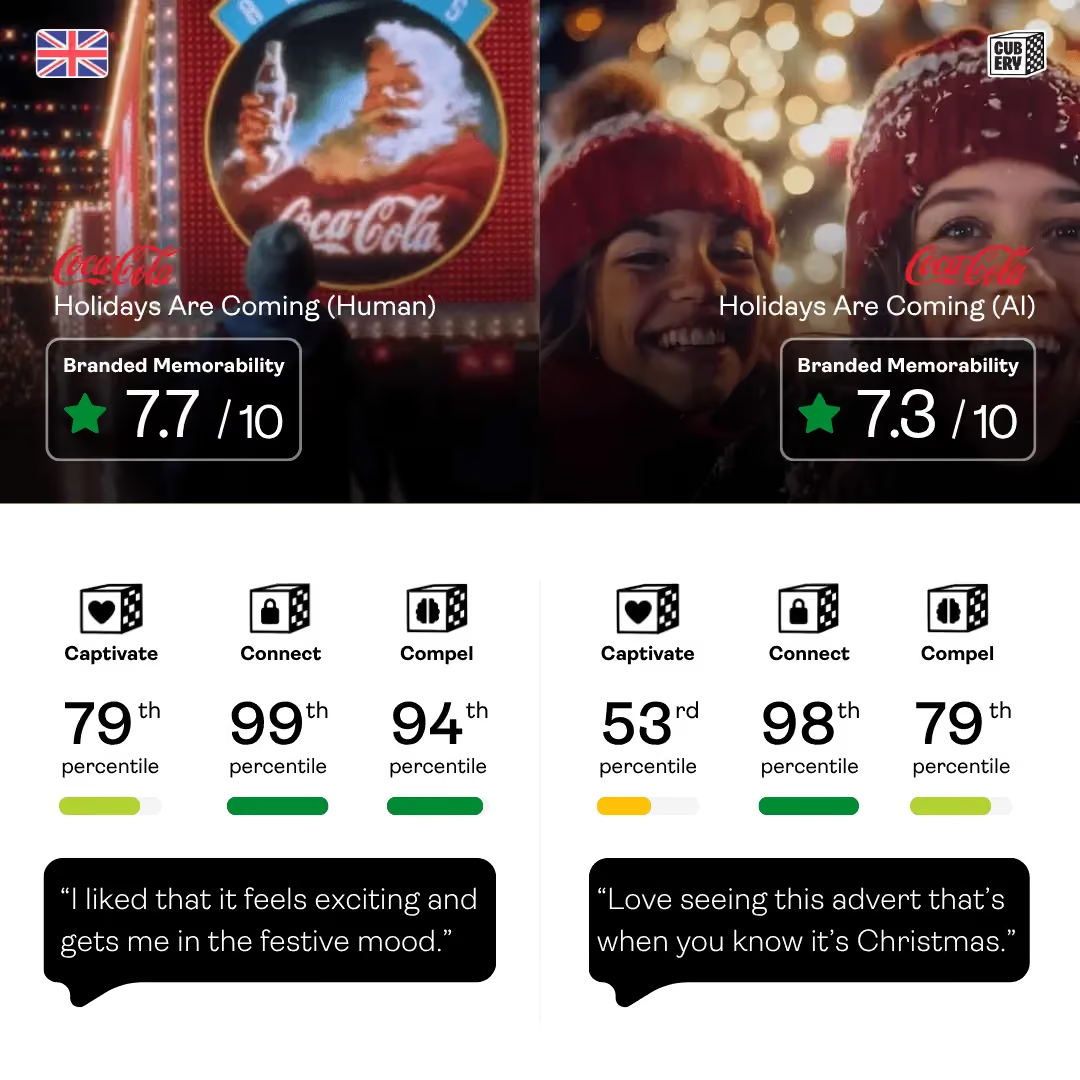
At Cubery, we test the creative effectiveness of advertising by speaking to real people, and AI-generated work is increasingly forming a part of the assets we evaluate for clients. A recent experiment by Puma offered a useful test case, with the brand simultaneously releasing “Go Wild” (by a human team) and “Agentic Prototype” (generated by AI). We tested both with U.S. consumers to understand how they landed outside industry debate and conjecture. The AI ad performed more strongly on several fundamentals, including message clarity, brand linkage, and emotional appeal. The human-made ad had greater creative ambition, but it also introduced a narcotics-adjacent gag that felt at odds with a global athletic brand, splitting the audience as a result. The AI ad was less daring, but ultimately more disciplined: it stayed on brief, stayed on brand, and delivered a single-minded message without unnecessary distraction. We’ve seen a similar pattern play out elsewhere. Coca-Cola's AI-generated “Holidays Are Coming” in 2024 drew significant industry criticism upon airing, but in our testing it performed very much in line with the brand’s prior human-made executions. The slight uncanny-valley wobble may have dented likeability, but all the fundamentals were still there: warmth, joy, Christmas, red trucks, and unmistakable Coca-Cola branding.

Coca-Cola offered arguably the best possible conditions for AI to succeed. The brand had already built a rich library of assets and associations over decades of exemplary consistency, giving the technology plenty to draw from. AI spent that equity, but it did not generate it. Locally, Allianz is taking a similar path, using AI to extend a well entrenched campaign platform.
The implications of the rise are already visible. Structural pressures across the big holding companies have been reported on extensively, with share prices reflecting anxiety, agencies restructuring, and clients moving more spend in-house or toward tech platforms. The business model and the creative product are being disrupted at the same time.
AI can follow a formula. And in advertising, doing that reliably, cheaply, and at scale has real value. But the AI ads that perform well are not especially original, just good enough. They draw on everything the creative industry has already produced: visual languages, emotional arcs, brand conventions, category codes, and storytelling devices. AI did not invent the formula for a high-energy sports ad, but it learned it and executed it faithfully. It can reproduce what has worked before with extraordinary consistency, but it cannot originate in the same way. It cannot feel the cultural moment, decide that the formula itself needs to change, and make that call with the judgement to know whether rule-breaking will land or simply confuse.
That is why the more interesting conclusion is not that AI will replace human creativity (or that it will fail to), but that it raises the floor without necessarily raising the ceiling. Work that used to pass as ‘solid’ now has a cheaper and often more consistent alternative. But that is also the opportunity. If AI can increasingly handle competent execution, then human creativity becomes more valuable where judgement, originality, and strategic nerve are required. If the industry’s defense is simply that humans can also produce competent work, it has no hope of winning.
So where should human creative energy go? The answer is further upstream, into the judgement-led work that AI is incapable of. For example, deciding that the category formula needs to change, identifying the cultural moment that makes rule-breaking effective rather than indulgent, building long-term distinctiveness that AI can later execute against (but never originate), and developing the strategic instinct that says, “our category looks like this, so we should look like something else.”
Human creativity built the foundations. The task now is to keep building and not defend what has already been learned. AI handling more of the execution layer should free human talent to do something more valuable: to originate, provoke, build meaning, and create the cultural and strategic foundations that AI will spend the next decade executing from.
Whether the industry takes that opportunity or spends the next few years arguing about whether it exists, is now the question that matters most.
Want to test your own advertising, packaging, or product ideas? Cubery combines a team of creative effectiveness experts with cutting-edge technology, bridging the gap between creativity and commercial impact. Get in touch to learn how we can unlock growth for your brand.
.png)