
Unfortunately, Internet Explorer is an outdated browser and we do not currently support it.
To have the best browsing experience, please use Google Chrome, Firefox, Microsoft Edge or Safari.
We use cookies to improve your experience on our website. By continuing to browse this website, you agree to our use of cookies. For more information, please refer to our privacy policy.


Curious about the 9 essential ingredients for creating advertising that drives profitable growth? Explore our Creative Effectiveness Playbook.
Being remembered is not enough for advertising to be effective. To do so, advertising must firmly entrench the brand in people’s long-term memories. That means uniquely ownable characters and other recurring devices aren’t just nice-to-haves in the pursuit of creative success – they’re absolute necessities.
Among the most impactful of these devices are brand mascots. Specifically, characters that are capable of delivering the one-two punch of emotional appeal and unmistakable brand recall.
The power of mascots comes from their ability to put a face to what would otherwise be faceless brands. Done right and this makes brands infinitely more personable, helping to build both emotional warmth and instant recognition. With these two crucial ingredients in place, advertisers are afforded the creative freedom to focus on their craft while safe in the knowledge that the brand won’t fall by the wayside.
To understand the makings of a truly great mascot, Cubery undertook a nationwide survey of over 1,000 Australians aged 18 and over, asking them to spontaneously recall their favourite brand mascot of all time. The results provide a fascinating insight into the role mascots play in building brands that endure, both locally and globally.
Taking out top spot in Australia was one of the world’s most recognisable faces: Ronald McDonald. Despite featuring less prominently in the fast-food giant’s marketing over recent years, the iconic clown continues to live on in the minds of everyday people – perfectly encapsulating the enduring power of distinctive characters.
Close behind in second place was Compare the Market’s iconic Meerkat trio: Aleksandr, Sergei, and Oleg. Highly visible across virtually every communications touchpoint since their introduction in 2013, the characters have embedded themselves into Australian culture as loveable and instantly recognisable, giving the brand emotional warmth in a category that can sometimes feel cold.
While it’s true that some categories struggle more than others to generate emotional engagement, this is where mascots, particularly animals, can be incredibly powerful. The meerkats, alongside the Dodo bird and HBF’s quokkas further down the list, are perfect examples of how animal mascots can simultaneously drive emotional connection and brand distinctiveness, particularly within more functionally led categories.
Rounding out the top three was a multi-generational icon in Mortein’s Louie the Fly, proving that brand mascots don’t always have to be the protagonist to be effective. While most mascots tend to work in bringing a warm and likeable face to a brand, the antagonist role played by Louie instead works to personify the problem, leaving the brand itself to take on the equally memorable role of heroic saviour.
From Frosty’s Tony the Tiger through to Smith’s Chips’ Gobbledok, the top ten highlights the instant recognisability of not only the characters themselves, but consequently the brands they represent – underlining their importance to enduring brand success.
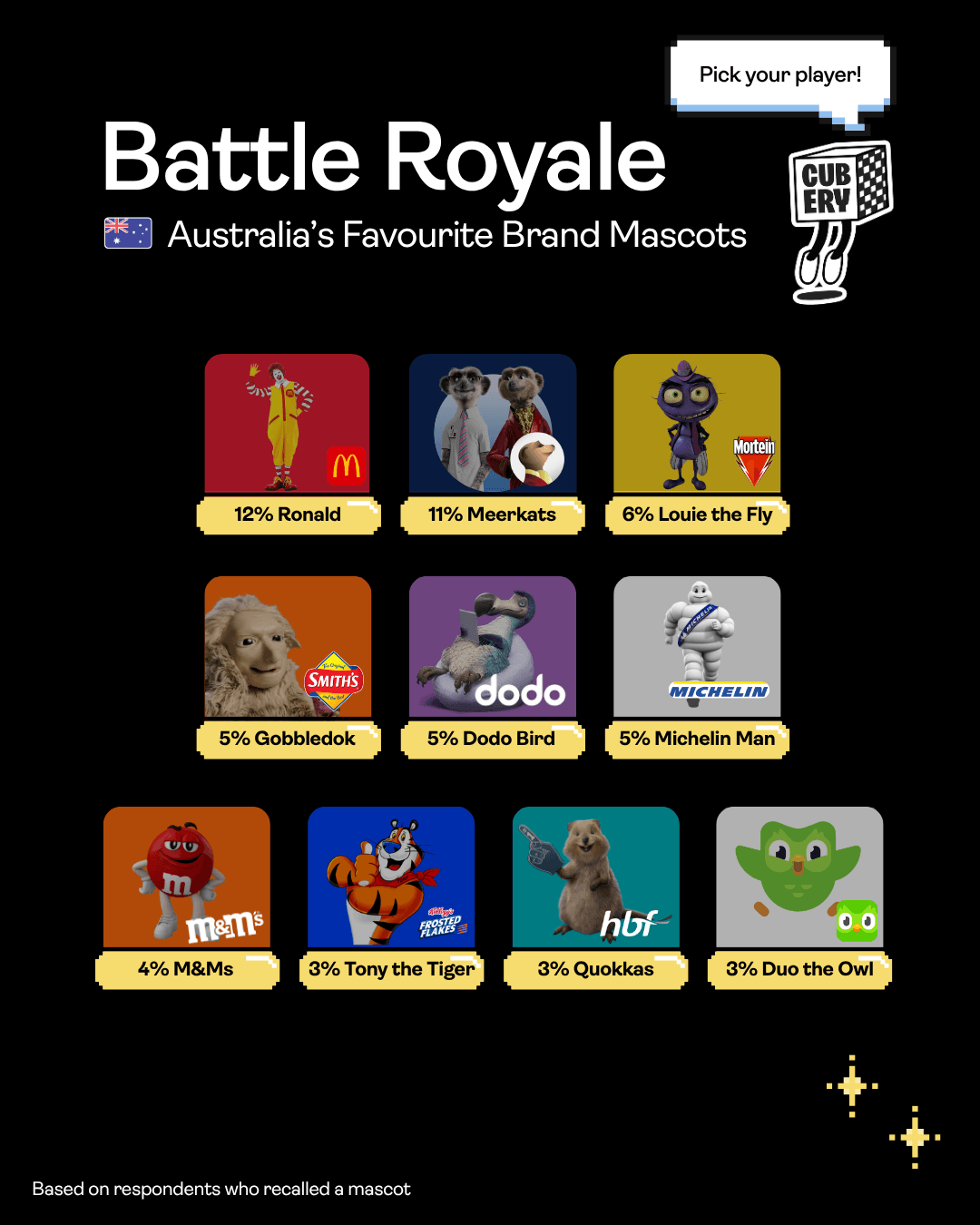
About the research: This research was conducted via an online survey of over 1,000 Australians aged 18 and over, capturing a broad cross-section of the population. Respondents were asked to name their favourite brand mascot of all time and explain what made the character memorable to them.
Want to test your own advertising, packaging, or product ideas? Cubery combines a team of creative effectiveness experts with cutting-edge technology, bridging the gap between creativity and commercial impact. Get in touch to learn how we can unlock growth for your brand.
.png)