
Unfortunately, Internet Explorer is an outdated browser and we do not currently support it.
To have the best browsing experience, please use Google Chrome, Firefox, Microsoft Edge or Safari.
We use cookies to improve your experience on our website. By continuing to browse this website, you agree to our use of cookies. For more information, please refer to our privacy policy.


Curious about the 9 essential ingredients for creating advertising that drives profitable growth? Explore our Creative Effectiveness Playbook.
Some of the world's most valuable brand assets aren't logos, taglines, or even audio devices – like many working in the marketing and advertising industry would’ve naturally assumed. Rather, they're the mascots that consumers can still instantly recognize, recall, and associate with a brand decades after their introduction.
While advertising trends, media channels, and creative techniques continually evolve, brand mascots have demonstrated remarkable staying power. And their longevity highlights a fundamental principle of modern brand building: brands grow when they’re easy to notice, recognize, and recall. As decades of research from the Ehrenberg-Bass Institute has shown, few branding assets contribute to mental availability more effectively than a distinctive and consistently deployed mascot.
But mascots offer far more than just entertainment – they provide visual and emotional shortcuts that make brands easier to identify in buying situations. As Jenni Romaniuk's work on distinctive assets has shown, the most effective brand identifiers are those that are instantly recognizable and consistently linked to a single brand. By combining personality, visual distinctiveness, and repeated exposure, mascots help strengthen memory structures over time, increasing the likelihood that the brand will come to mind when a need prompting the category arises.
To understand which mascots have achieved cultural staying power, Cubery surveyed more than 1,200 American adults and asked them to spontaneously name their favorite brand mascot of all time. This revealed the assets consumers were able to retrieve from memory without any prompts or cues, providing insight into which characters have successfully embedded themselves in people’s long-term memory and become synonymous with the brands they represent.
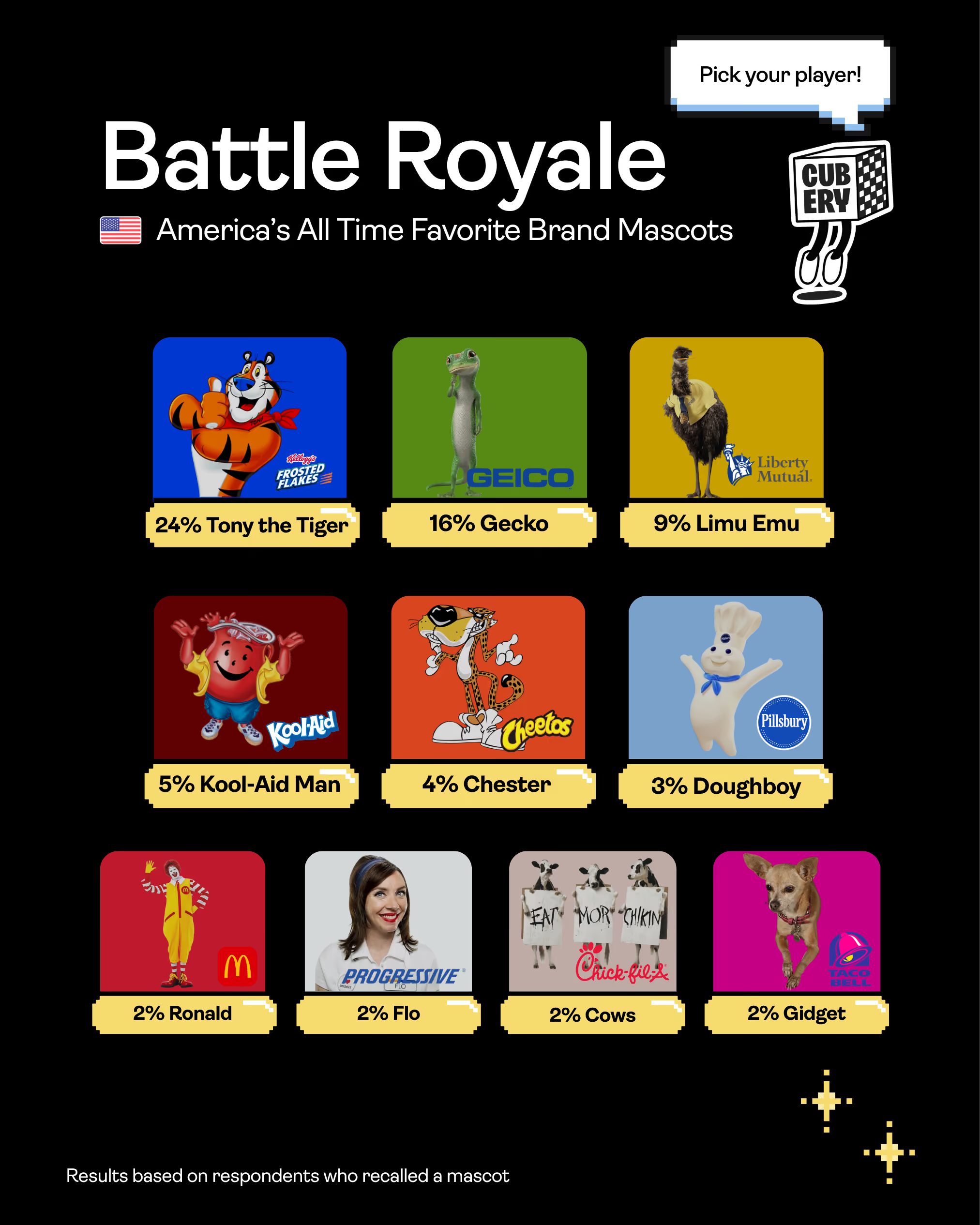
In a genuinely "Gr-r-reat!" result for Kellogg's, Frosted Flakes icon Tony the Tiger claimed the number one position – by a considerable margin. Since his introduction in the 1950s, Tony has appeared consistently across the brand’s packaging, advertising, sponsorships, and retail environments, creating endless opportunities for the brand to be encoded and reinforced in memory. This consistency is a hallmark of the world’s most enduring brands. Rather than relying on short-term creative novelty, Kellogg's has invested heavily in repeatedly strengthening the same distinctive asset over multiple generations, allowing Tony to become one of the most recognizable brand characters in American marketing history.
Importantly, Tony's success is not solely the result of his longevity, but rather of disciplined evolution. While his design has been refined over the decades to reflect changing artistic styles and cultural expectations, the core characteristics that make him recognizable have remained firmly intact. This balance between consistency and evolution reflects a key principle of asset management: branding devices become more valuable as memory links strengthen over time. While brands can refresh executional elements, changing the fundamental cues consumers rely upon to retrieve the brand can weaken the memory structures that have been built through years of exposure and repetition.
A similar dynamic played out with Ronald McDonald. Although he appears less prominently in communications today as a result of McDonald's evolving its broader brand positioning, Ronald remains one of America's most recognizable mascots. This demonstrates the compounding value of building strong memory structures.
Once a brand has established distinctive associations across generations, those associations continue to deliver value long after media support has ended. Ronald's continued presence among consumers' favorite mascots illustrates how ongoing investment in distinctive assets creates enduring competitive advantage that persists long beyond an individual campaign or marketing cycle.
Beyond consistency, one of the other key reminders provided by this research is the ability for characters to trigger positive emotion. From the mischievous confidence of Chester Cheetah to the exuberant energy of the Kool-Aid Man, the most memorable characters entertain as much as they identify. This matters because emotion plays a critical role in memory formation. Researchers including Antonio Damasio and Daniel Kahneman have shown that emotionally engaging experiences are more likely to be encoded, retrieved, and acted upon than purely rational communications. Effective mascots therefore strengthen both memorability and brand meaning simultaneously.
This becomes particularly valuable in low interest categories or those that don’t naturally spark a high level of emotional engagement. Insurance is a prime example. Most consumers spend little time thinking about insurance outside of specific purchase occasions, making it difficult for brands to build salience through product messaging alone. In these circumstances, distinctive assets become disproportionately important because they provide simple, memorable cues that help brands remain mentally available despite relatively limited category engagement.
The success of Geico's Gecko, Liberty Mutual's Limu Emu, and Progressive's Flo reflect exactly this principle. By attaching memorable personalities to otherwise functional offerings, these brands create mental shortcuts that make them easier to identify, distinguish, and recall. Rather than relying solely on product claims that competitors can easily replicate, they have invested in assets that continuously reinforce memory and brand recognition. Their prominence within the rankings is a powerful reminder that when distinctive assets are consistently deployed over time, they have the ability to become one of the brand's most valuable sources of competitive advantage.
Ultimately, the mascots that endure are those that become far more than just advertising characters. Through decades of consistent use, distinctive execution, and emotionally led storytelling, they evolve into powerful cues that keep the brand mentally available. These findings reinforce a critical learning: brands grow not because consumers maintain deep relationships with them, but because they are more easily noticed, recognized, and recalled in buying situations. America's favorite mascots have mastered this challenge, ensuring their brands remain front of mind long after the campaigns featuring them have faded from memory.
Want to test your own advertising, packaging, or product ideas? Cubery combines a team of creative effectiveness experts with cutting-edge technology, bridging the gap between creativity and commercial impact. Get in touch to learn how we can unlock growth for your brand.
.png)